Showing posts with label vintage books. Show all posts

Tuesday, March 24, 2009

CPSIA and Vintage Books 6: Rally 'Round!


Illustration by Marjorie Torrey, copyright, 1956, Random House
The illustration above (and the close-up detail below) are from my childhood copy of Favorite Nursery Songs, compiled by Phyllis Brown Ohanian and illustrated with delicate watercolor and pencil pictures by the Caldecott-honored Marjorie Torrey. The book, my favorite songbook when I was growing up, was published in 1956 and has been out of print ever since.
Detail from "Ring Around a Rosy"
More about Ms. Torrey's charming illustrations in a minute, but first I want to encourage everyone who can possibly make it to join me in a trek to Washington D.C. for a fly-in, rally, and Congressional briefing on Capitol Hill to amend the CPSIA. You can get all the details, including the info on hotels offering special deals for the event, at a special website here.

Rick Woldenberg of Learning Resources, Inc. (see his CPSIA blog here) has been helping to organize people from many affected industries, large and small, to get our voices heard by Congress. I'm trying to schedule meetings with my senators and representative as well - and I'm taking my teenage daughter, so she can see political activism at work in person (and put in her two cents worth too). I'm planning to leave from Pittsburgh very early on the morning of the first and return in the evening. I have a minivan, and if anyone from the area needs a ride, just shoot me an email and we can work out the details.

Copyright Random House, 1956


Detail from cover
Isn't the cover of this book beautiful? The quality of the color reproductions was really quite remarkable for the era, too. You can readily see the rough texture of the watercolor paper, as well as the soft layers of washes and the nuances of the pencil lines. I think it's notable that these images still come vividly to mind more than 45 years after I first saw them the moment I hear the familiar first lines of songs like "Row, Row, Row Your Boat" or "Here We Go 'Round the Mulberry Bush."

Here's a glimpse of the illustration for the former song, as well as a closer look at a couple of the figures. There's a real sweetness, without veering into saccharine. The botanical elements are consistently precise and beautiful. 


I spoke recently with Joe Martyak, the chief of staff at the CPSC, for information about how CPSIA affects children's books, literacy programs, libraries, and the sale of the original art from children's books for an article I'm writing for the Society for Children's Book Writers and Illustrators (SCBWI - visit their website here) and for an opinion piece with a similar theme I'm working on to submit to the Pittsburgh Post-Gazette (which ran one excellent article on CPSIA and dirt bikes but has otherwise ignored the whole thing). Although much of what Mr. Martyak told me could be construed as encouraging from a short-term perspective (he didn't think the CPSC would be going after libraries, literacy groups, booksellers, etc. any time soon due to low priority and lack of resources), my overall mood is one of gloom for the future of children's literature's past unless Congress agrees to try again with the CPSIA. He was clear that their preliminary testing  finds many older books hovering around the 300 ppm level - the standard which goes into effect in August. (This is destructive testing because XRF testing is not particularly helpful for books since it can only measure the lead in a particular spot which tells you little about total lead) An even stricter standard of 100 ppm goes into effect in August, 2011, at which time my guess is that few old books will pass.

Mr. Martyak did his best to ask my specific questions, but it's clear there's just much that he and the agency have not yet figured out. And that of course is just one of the many, many problems with passing a tsunami of a law and rushing it into enactment: there are a nearly limitless number of details and judgment calls with a law like this, and no matter how hard-working or well-meaning the folks at CPSC are, they will simply not be able to sort them out any time soon, not in the next year, probably not in the next five. For example, he had no idea how the law would be applied with regard to schools (who become manufacturers under a strict reading of the law when they create unit packets with comb bindings - or when they even just staple a pile of papers together). He thought that the publishers who produce inexpensive staple-bound paperbacks could get away with just testing the staples (since for now "ordinary books" are exempt from testing), but it sounded to me in other published CPSC advisories like deviating from the ordinary book definition meant the whole product had to be tested. And Mr. Martyak had not realized the agency had used different definitions of ordinary books, nor whether that signaled a shift in interpretation.
I love how she handled the challenge of facing pages that couldn't really bleed together, given the printing limitations at the time.
Aren't the cherry blossoms breathtaking? And they should be in bloom on April 1st for the rally. Of course, that baby should be sleeping on his back, in an approved, labeled crib. Hope there aren't any fasteners or phthalates in that sleeper. On the whole, I think the CPSC investigators would have a field day, as would CYS.

Right now, those of us who oppose the CPSIA are largely at the wind-blowing stage. (The ATV industry and the thrift stores too are past that though). But the bough-breaking phase is not far off - next February 10th will herald both the testing and certification mandates - and the end of many more businesses and safe, useful products. We need to take action now, before disaster strikes.
Not sure if this guy is looking for his little dog, or for the toys, books, and clothes he used to have.

One of the extra elements common in older books are illustrated endpapers, like those above. You still see them in some picture books today, but much less frequently since they're an added expense, as well as more work for the illustrator (who is generally paid the same whether or not the end papers are illustrated). Endpapers are not usually included when a hardcover is reprinted as a paperback, which is yet another reason to prefer the older editions.

The description below is from a bio of Marjorie Torrey (who was also an acclaimed mystery writer) by Tom and Enid Schantz that appeared in the Rue Morgue Press in 2002:
"But it was her work as an illustrator that brought her fame and awards. Her first Caldecott Honor book, Sing Mother Goose, with songs by Opal Wheeler, came in 1946. The following year she earned another Caldecott Honor medallion for illustrating Sing in Praise: A Collection of the Best Loved Hymns, once again selected by Wheeler. A Caldecott historian wrote of her work: 'The full-color illustrations reflect the solemnity and reverence seen in Torrey’s Mother Goose collection, and these interpretations communicate the essence and importance of the songs’ words…Torrey’s gentle black-and-white illustrations possess the softness of pencil, some the sharp lines of pen and ink, and others a combination of both.'...All of her books are out of print today. Even her Caldecott honor books are difficult to find, often confined to rare book rooms or the special collections section of larger libraries."
You can read the whole article here. And despite the rarity of her books (which my attempts at searching for them confirm), you can still find a few inexpensive copies (see these amazon listings for the song book I own), meaning the volumes likely won't qualify as collectibles under CPSIA standards - so better get a copy while you can.
Ms. Torrey was also well known for her version of Alice in Wonderland.
I'm hoping someone decides to republish her work.

Here are two more CPSIA articles on books in the MSM: a Washington Post article that ran in the health section, and one from the St. Petersburg Times here. Very discouraging, but I think Congress ought to take a look at the typical comments about this law. Don't know who those constituents are that they claim are pestering to preserve the law unchanged, but they're not exactly vocal in public.


Sunday, March 08, 2009

CPSIA and Vintage Books: A Terrible, Horrible, No Good, Very Bad Law


I went to sleep with no coffee in the house and when I woke up there was still no coffee in the house and the garbagemen came before I could stick the smelly leftovers in the can and then I found an even stinkier new statement from the CPSC about books, and I could tell it was going to be a terrible, horrible, no good, very bad day.

I think I'll move to Australia.

If you've ever read this childhood classic by Judith Viorst with expressive black and white line illustrations by Ray Cruz (Atheneum, 1972,), I'm sure you get my literary allusion. And if not, here's the first page as a teaser - you have got to read this book, which is still completely relevant and delightful 37 years after it was published. It's just as appealing to adults as it is to kids.

Copyright 1972, Judith Viorst and Ray Cruz

So here's why it was a THNGVB day. The CPSC put up some new "helpful" powerpoint slides for their staff today (you can read them all here).

Here's the line that's got me ready to move to Australia. Or, better yet, ready to make Congress move to Australia and let the country start fresh. Page 6 has the guidance on children's books (ordinary books safe if published after 1985, limited staff analysis has shown some lead in older books, blah, blah). And then this line:

Children’s books have limited useful life
(approx 20 years)

I had to read this statement about a dozen times before I could believe it really said this.

What planet do these people live on? Have they never heard of Winnie the Pooh? The Wizard of Oz? Peter Pan? Alice in Wonderland? Peter Rabbit? Charlotte and Wilbur? Mike Mulligan and Mary Ann? I could go on for quite a while.

Maybe, my son suggested, they were referring to the physical book, that volumes wear out after 20 years. Except that's equally asinine. You don't have to be a rocket scientist to figure out that there are millions of copies of children's books published and printed before 1989 that are still in excellent, completely useable condition, with content still just as capable of stirring the souls of children or tickling their funny bones or teaching them something interesting. Otherwise, there'd be no one out here making a stink about old books, but there are tons of us.

Well, maybe, said my Devil's Advocate, they were referring to library copies which can get some pretty tough wear and tear. True - but libraries are still sweating bullets about having to purge the pre-1985 books from their collections, which makes me think those old books are surviving at a pretty high rate. Doesn't surprise me, when you consider the industrial strength of some of those bindings and the fact that past the age of 2 or 3 kids start to treat their books with a little more respect.

In fact I recently finished reading a truly outstanding library book, Mine for Keeps, by Jean Little (Little, Brown, 1962) and although after 46 years the cover art looked faded, there weren't even any ripped pages or significant stains or anything else that would make this book unusable. And the content, about a girl with cerebral palsy who struggles to fit in at her local school after returning from a special boarding school was timeless and universal. I really cannot recommend a book more highly. I read it first when I was in 2nd or 3rd grade and when I rediscovered it I was overjoyed. What's really wonderful about this book is, despite my initial description, is that it's not so much about a girl and her disability as it is about the typical kid challenges faced by a girl who also just happens to have CP. That's an important distinction, and it's only part of what makes this book so great. (It's a great dog story too.)

Illustration copyright 1962, Lewis Parker
I'm now reading my way through all of Ms. Little's sensitive, moving books (thanks to the many amazon sellers who haven't yet been forced to remove their inexpensive non-collectible copies of vintage kids' books), including her memoirs, which I also strongly recommend. In the first volume, Little by Little, there is a hilarious scene in which Jean, who is blind from shortly past conception, subs for a last minute scratch in a championship college intramural basketball game. Today that scene would have been videotaped, become a viral youtube video and been re-broadcast on ESPN and all the morning talk shows.

No, the CPSC's completely ignorant statement is the equivalent of saying that we have no need of Rembrandt, Matisse, or da Vinci paintings since some perfectly nice ones have been made in the last 20 years. No need of Shakespeare, Jane Austen or Dickens when you can read John Grisham or Janet Evanovich (not that I have anything against those latter authors - fine beach reading. In fact, Grisham could write a pretty good thriller featuring an evil congressman in cahoots with the consumer lobbyists and aided by a nefarious CPSC enforcer as they pursue a beautiful crafter fleeing with his movie-star beautiful fiancee, the vintage bookseller.)

I had started a completely different post about the impact of CPSIA on literacy programs (I've been collecting info from several prominent ones), the economics of binding, and the research on the link between lead poisoning and exposure to books and educational toys (which I have a feeling will surprise Congress). But I'll save it for tomorrow.

Let this sink in meanwhile: Mary Poppins: irrelevant. Pippi Longstocking: useless. Babar, Ferdinand, Curious George, Frances, Corduroy, Harriet the Spy, the Very Hungry Caterpillar, Madeline, the Borrowers, Little Tim, the Runaway Bunny, Max in his wolf suit, Horton and the Whos, the Grinch, Sam-I-Am, Amelia Bedelia: who needs them?


Now this book above you might argue is an example of why a children's book is "useless" after 20, well, more like 40-some years. As you can see from the cover, this volume has had a long, rough life. The Trolley Car Family by Eleanor Clymer (David McKay, 1947 - my copy is from the late 50s or early 60s) was one of the many books in my family's collection of "bathtub books." The house we moved into when I was 10 had a huge claw-footed bathtub on the third floor, and my sisters and I spent substantial chunks of our moody teens in it reading and re-reading our favorite childhood books. But even though this book's cover is rather the worse for the wear and it's a bit wrinkled from too much hot water and Calgon, it still has all its pages. Twenty years after its bathtub duty, my own kids enjoyed sharing the old-fashioned adventures of the family who was forced to move into the trolley car their dad drove until the trolleys were replaced by more modern buses, Pa lost his job, and the family was forced out of their home.

Come to think of it, a story about job loss, home foreclosure and useful things deemed obsolete doesn't sound so old-fashioned these days, does it?

Thursday, March 05, 2009

CPSIA and Vintage Books 3: Girl Eats Dangerous Vintage Book; Gets into Yale Anyway


The book above, by the renowned English illustrator L. Leslie Brooke was my first literary love. There's no copyright date in my copy (not too unusual with older books), much less a printing date (also not unusual, even in books printed since 1984), but I'm guessing from the copies I've located online that it was published in the 1920s. It has to have been printed prior to 1958 (when it came into my family's possession) but whenever it was published, it's clearly in the suspect category of pre-1985 books. It's long, long out of print, somewhat rare, but not apparently in the too valuable to be given to a child, as I easily located three copies online today, all for less than $20 (which is less than many new hardcover nursery rhyme collections retail for). (Some of Brooke's books have been preserved by the Gutenberg Project, but this is not one of them.)

My mother began reading to me as soon as I was born. I enjoyed all the books she shared with me and my older sister, but this book was my hands-down favorite, and the page above, an illustration from the rhyme "Cock-a-Doodle-Doo," was the one I loved best of all. I loved it so much that I "kissed" it (in the big open mouthed slobbery style typical of babies) until it simply dissolved into a pulpy, mushy mess. I was terribly sad when it was gone (though that didn't stop me from loving many other pages in the book to mush), so my kind grandmother Kee gave me this replacement copy for Christmas that year, when I was 15 months old. This copy shows no signs of having been chewed or licked at all and is in remarkably good shape considering that in the years since I have often used it for artistic inspiration/reference, and I also read it to all three of my kids many times when they were babies and toddlers. 

Despite my consumption of this evil, almost certainly lead-laced vintage book (look at the bright reds on the rooster), and despite growing up in a generally lead rich environment (I've lived my whole life in older homes, several of which were extensively renovated while I was in them, drank tap water that flowed through lead-soldered pipes, played and gardened in soil undoubtedly contaminated by the leaded gas that was used then, and of course always had my nose buried in those dangerous pre--1985 books), I managed to be accepted to Yale, and even graduate with honors. And then I went onto the University of Virginia where I got an M.Ed. and a Ph.D. in clinical child psychology.

There are several reasons this story is important with regards to CPSIA. First, the way I loved my book with my mouth as well as my eyes is typical of babies.  Few babies actually consume pages (especially now that board books are widely available and much sturdier), but most do lick, suck and chew on the cardboard pages. Thus the people who worry about babies' lead exposure are right to be concerned about whether books pose a lead poisoning hazard. And based on my reading and the reactions of many parents when I tell them about the law, parents are scared of books now (and not just the vintage ones). See this article and the comments on Parent Dish and this piece by an Australian pediatrician if you doubt that.

This by no means though indicates that I think the CPSIA position toward vintage books for kids 12 and under is even remotely reasonable. Note that although I devoured my first copy of the book, the second copy is unmouthed, despite many more years of loving. This pattern is actually fairly typical. As this research study indicates, children's "mouthing behavior" peaks between 6 and 15 months and by age 3 years, the licking and chewing of inappropriate objects has dropped to quite low levels . This is why both the U.S. and the EU have special "small parts" rules for toys intended for children below the ages of 36 months; after that, it's reasonable to expect that most typically developing children will have learned not to put unacceptable items in their mouths. (Interesting side note: according to many parents from my own folks' generation, mouthing of books ended at a much age than it does today; because there weren't sturdy board books available, parents taught even little ones to treat books with more care.) 

It is thus hard to understand why on earth Congress fought hard to extend the age range under CPSIA to 12, well past the age when mouthing is a concern. The only explanation I've seen is that some consumer groups argued that young children sometimes play with their older siblings' toys; by that argument, though, we ought to limit lead severely in ALL products for any age, since youngsters also get into their parents' things (ever seen a baby chewing on Daddy's keys or sucking Mommy's shirt?) and have frequent exposure to household objects meant for use by the whole family. Yet we're not regulating lead in bathtubs, sofas, kitchen utensils, TV remotes (another favorite of the small fry set), cell phones (saw a baby chewing his grandma's today at Costco), or the family car, which is definitely a lead and phthalate hazard (in the battery, in weights used to balance wheels as well as other metal alloys, with phthalates likely in the vinyl components). By the way, I'm not arguing for an adult version of CPSIA; the economy is tanking well enough on its own and with this law without more onerous provisions to push it over the cliff. I'm just saying.

The question remaining that I haven't answered of course is whether it matters that a baby sucks on a book with lead in the printing inks. I've been combing the internet, trying to track down research about the absorption of lead from ink, and I think it's intriguing that there are no reported cases ever (that I've been able to find) of anyone being harmed by the lead in ink. You'd think the occasional bookworm, printer, or literary-minded toddler would show up with a case of lead poisoning traced back to the printed word (or picture). I did, however, find this old NIH study that examined the pH conditions that caused lead to leach from printed paper; stomach acid pH did cause some leaching, but saliva level pH did not. This finding suggests that babies are likely only at risk if they're consuming the pages (as I did) -- but that ordinary gumming, sucking, and licking is not a problem. Maybe a little parent education to discourage them from letting babies eat paper would be good -- look at the success of educational programs like "Back to Sleep." Not every problem needs a heavy handed law to solve it.

I'm sticking in a few more illustrations by L. Leslie Brooke here, to give you a little break from so much reading in case you're too lead-damage to sit still and pay attention for long. This is another illustration from the same book ("Simple Simon" fishing for a whale in his mother's pail).

The next is the cover of one of Brooke's best known books, also a vintage copy. It at least is available in post 1985 copies, though none is close to as nice in quality as this.
The picture below is one I made in high school as an illustration for a story I wrote for my much younger brother. You may be able to detect the influence of Brooke (and also Beatrix Potter). I was so lucky to have had the outstanding reproductions in my old books, which were printed on a heavy, glossy stock that really brings out the subtle layers of wash and the textures of the brush strokes and pen and ink. 


Okay, now for the big finale. It would be just as silly to conclude that eating a lead book caused me to get into Yale (or that it was harmless and irrelevant) as it is for CPSIA to conclude that these old books are so dangerous that they must be kept from everyone under the age of 13. The fact that two things occur together (they are "correlated" in the lingo of science) does not indicate that one caused the other. (Obviously, but for my lead exposure, I'd be another Einstein.)

Just kidding, of course. But it's not silly to hypothesize that there is a cause and effect relationship between wide and frequent exposure to books and school achievement. This correlation has been known since at least the 1920s (and probably suspected by many teachers and parents before then). And that's why it's such a tragedy that CPSIA could lead to the loss of so many books. Aside from the fact that it will reduce the variety of children's books (since most have never been reprinted and never will be), it will also decimate the number of inexpensive or free books available to children. It's easy to find vintage books for as little as a quarter at library or yard sales or thrift shops (or at least it used to be) - try to find a new book available for that. Even more importantly, books published before 1985 make up a significant portion of the collections at many public and school libraries. Particularly in these tough economic times, they'd be unable to buy newer replacements for even those that had new copies available. Finally, older children's books were often more intellectually challenging than today's books; they used bigger vocabularies, more complex sentence structure, and overall more demanding texts.  (I'll try to add sources for all these claims tomorrow - I'm ready for bed now.)

Wednesday, March 04, 2009

CPSIA and Vintage Books 2 - and Silhouette Art

Sara Reading, copyright 1997
I love silhouette art. The stark black and white contrast, the carefully picked out details, the sense of shape and mass - just utterly beautiful to me.  I remember going to have my portrait cut as a child in Cleveland by the silhouette artist Wally Spatz, who was a traveling regular to department stores around the midwest. Her speed and accuracy were truly amazing.

I cannot even approach her finesse with scissors, and I definitely can't work freehand. The portrait above is a papercut made from a drawing I did of my daughter Sara and was loosely modeled on a black and white woodcut silhouette of a nude on a bed by the Swiss artist Felix Vallotton. I transferred the drawing onto black silhouette paper and cut it out with an xacto knife (and it took many, many hours). I always cut the smallest interior "whites" first, and save the largest areas for last.

I trace my own interest in this kind of art back to even before I had my own silhouette cut, to children's books illustrated with silhouettes, created in a number of ways. I owned several Arthur Rackham books, and he often had spot silhouette illustrations, though I believe they were largely pen and ink creations. You can find materials and learn techniques about making silhouettes here, and read more about the history and techniques of silhouette art here.

The book below, Rhymes About the Country, features some outstanding silhouette illustrations, the kind that made me catch my breath as a child and still do. They rhymes too are sweet and funny and great to read aloud, which I did often with my own kids. The book, written and illustrated by Marchette Chute, was published by Macmillan in 1941, and was reprinted a few times in the 1940s and never since. Ms. Chute died in 1994 and you can read her NY Times obituary here

This book might fall into the rare half of too rare and valuable to given to a child under CPSIA, as I was only able to locate a handful online - but at prices ranging from $8 to $19 it hardly qualifies as too valuable. Too bad, because as rare as this lovely book already is, there's a good chance it could end up discarded into extinction by booksellers worried about lead liability and not willing to spend money on an $8 book for XRF testing to find out if it's okay or not. (And of course when destructive testing goes into effect next February, it would not be possible for a seller to test it, since I've yet to find any who have more than one copy).I love both this illustration and the poem that it accompanies. Made my kids laugh every time I read it. Ms. Chute had a real knack for cutting objects so that your brain "filled in" the blanks - you easily "read" the curved shapes by the bat as a playground ball. And you can feel how the child has tipped his weight forward along with his chair. Masterful.
The illustration above is just stunning to me. I hope someone somewhere has preserved the original silhouette art for this book.

Books like this one tend not to be reprinted. The poems, although they scan perfectly and are in touch with a child's psyche, would be categorized as "quiet" and therefore not likely to make a big enough splash in today's children's market. Also, I'm not sure what the deal is with the copyright of this book. Perhaps it's out of copyright in which case the Gutenberg project could at least scan it and preserve it that way. (Copyright laws have changed over the years and I find it tricky to figure out which one applies. Currently, books get the author's life plus 70 years -- and that's a discussion for another time.) Black and white only illustrations are also rare since color printing became inexpensive and easier. (Illustrators used to have to make time-consuming and technically challenging "color separations" to reproduce the colors in their final art; I for one am very glad to be well past that era; I think it would have exceeded my skill.) Publishers today see kids as more drawn to colorful artwork, and perhaps they're right, but I'm convinced nonetheless that there are many kids who would still enjoy these charming illustrations. (There are some exceptions. This year's Caldecott winner, The House in the Night, illustrated by Beth Krommes [and written by Susan Marie Swanson] features black and white scratchboard art, with touches of yellow. It's a beautiful book and a timeless, and quiet goodnight story. Maybe it bodes well for Marcette Chute's books.)
These last three silhouettes are by me. They're portraits of my three kids that I gave to my in-laws as part of a larger piece featuring all their grandkids. The technique and poses, so different from the traditional head and shoulders profiles I remember from my Wally Spatz portrait, were inspired by Ms. Chute's art. (I'll be hanging onto my copy and writing a fierce note to my heirs to keep it out of the trash bin.)

I'm keeping my fingers crossed that CPSIA goes away before every copy of Ms. Chute's lovely books do.

Tuesday, March 03, 2009

CPSIA and Vintage Books: Lotta on Troublemaker Street

This is my childhood copy of Lotta on Troublemaker Street by Astrid Lindgren (of Pippi Longstocking fame), translated from Swedish by Gerry Bothmer and sensitively illustrated by Ilon Wikland. 

It was published by Macmillan in 1963, putting it in the category of pre-1985 books made suspect by CPSIA. I found a number of used copies from online booksellers, ranging in price from $3.20 up to about $35, so it doesn't fall into the protected category of a book that's of sufficient "value and age [that it] wouldn't be expected to be used by children." (CPSIA guide pamphlet, p. 12) Given the SmartMama's experiences with testing the inks in older books, I wouldn't be surprised if the bright reds on the cover and in most of the interior illustrations would fail the 600 ppm lead limits now in effect (and the limit will drop to 300 ppm in August, and later to 100 ppm). All of this means that the book probably falls into the "hazardous waste - discard" category of CPSIA (if I were thinking of getting rid of it, which I'm not).

It was a gift from my grandmother for my 5th birthday, and it was the perfect choice for me, seeing as it was about a five year old girl remarkably like me. Not only did the Lotta of the illustrations look quite a bit like me, with blond hair flying every which way, but she had the same sense of being treated unfairly by her family that I was prone to at that age, as well as my fierce temper, independent streak - and loving heart. It's small wonder that I demanded that my parents read this short chapter book to me over and over until I learned to read myself and could satisfy my need to return to the familiar, comforting pages. I read it repeatedly to my own three kids, who also loved it (though only one shared my fierce temperament), and I've still not tired of reading about how everyone is so mean to Lotta and her beloved Bamsie, the piggly bear.

Lotta wakes up one day in a crabby mood after a bad dream, and the morning goes downhill from there. After Mother unreasonably insists that Lotta wear the sweater her grandmother made (which "tickles and scratches") rather than her Sunday best blue velvet dress (boy, were these familiar details in my world!), Lotta pouts in her room, forbidden to come to breakfast or join in the shopping trip until she gets dressed. After she cuts up the tickly, scratchy sweater, she's struck by remorse, blames it on a dog and decides to run away. Fortunately, Mrs. Berg next door has a nice little treehouse-like room above her shed, and it's available for Lotta to set up her own "househole." You'll have to get a copy of your own to read the rest of Lotta's adventures and the reassuring ending.

Ilon Wikland's illustrations so perfectly capture the mixture of anger, misery, regret, and inability to make things right that Lotta experiences as she digs herself into a deeper and deeper hole with her pouting and tantrum. And the details are wonderful, like Lotta's slipped down stocking and the grubby look of the well-loved Bamsie.

You can really feel Lotta's relief and Mother's love and understanding in this illustration near the end of the book. The lines and textures are lovely and so appealing to me.

This edition of Lotta was reprinted several times in the 1960s but then fell out of print. In the early 1980s, the story was republished by Simon and Schuster with illustrations by Julie Brinkloe. That edition is also out of print, suspect under CPSIA guidelines, and actually harder to find than the editions from the 1960s. More recently (2001), it was reissued as an Aladdin paperback, with illustrations this time by Robin Preiss Glasser, and it is still available from amazon.

But that is small comfort to me. A paperback is NOT the same reading experience as a hardcover (even the size and shape are different), and although I've not seen the whole book and I've nothing against Ms. Glasser as an illustrator in general, well, her cover illustration just does not capture the same feeling at all to me. 
This Lotta lacks the innocence of the Wikland's Lotta and she even looks older. She seems sassy, rather than spunky, an important distinction to my mind, and of course, she's just not the Lotta who's almost as familiar as a family member to me and my kids. I'd buy this if I had no other options, but I'd feel sad indeed.

Below is the inscription to me from my grandmother that's on the flyleaf of my copy.
I've stuck this in, because of course it's part of what makes this book so valuable to me. If CPSIA were to "recall" these older books and insist that they be discarded, or if they threatened caregivers with abuse charges for letting children handle them, well, I'd be forced to take a Charleton Heston stand, vowing to relinquish my book only when they pried it from my cold, dead hands.

And that's significant omission in regards to this law. Because every other time that CPSC has classified a children's product as dangerous, they've issued a recall, suggesting that parents return the product or discard it. Why haven't they done that with the millions of products now deemed so dangerous to children that they can't even be sold at a yard sale or given to the kid next door?

I suspect for several reasons. First, it simply wouldn't be practical. Landfills would be overrun, there'd be a tremendous public outrage, and it would kill the bookselling and publishing industries. But more importantly, I suspect it's because the risk from most of these suddenly illegal products is really quite small. And so it makes me extra, extra sad that so many of these books will likely be lost forever before long.

I had to buy an extra copy quickly before the CPSIA police catch up with the online sellers. Now I'm thinking I should buy a couple more, so each of my kids will have one to share with his/her kids.


CPSIA Updates

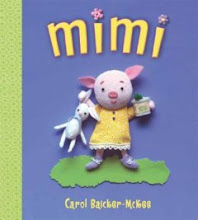
Illustration from my picture book Mimi, Bloomsbury, copyright 2008

I'm back again and apologize for the break. I've been busy with work and family, but also with following and fighting the Consumer Product Safety Improvement Act which I blogged about earlier. I never used to think of myself as an activist, but for the past six months I've been getting my hands dirty with the political process, and I do believe it's possible, though not easy, for ordinary people to join together and have a real impact on the direction of our government. 

In the case of this law, I believe it's essential for us regular people to get out there and fight it.

Since I last blogged about CPSIA, there have been a number of developments. Most significantly to me as a children's book author and illustrator, the CPSC ruled that "ordinary books" (i.e., not novelty books or those with spiral or staple bindings) printed since 1985 can be presumed to be lead free and don't have to tested. This is a huge help to publishers of new children's books who can cross at least one giant threat to the kids' book industry off the list, as well as to us authors and illustrators who can worry less about their recent books being pulled from school, library, and bookseller shelves, and maintain hope that there will continue to be publishers out there to buy our new manuscripts. (Plus we can continue to donate copies of our books to literacy groups and libraries, as well as give copies to friends' kids without looking over our shoulders for the lead police.)

The other ruling that has made me sigh with relief is the one that items made 100% from a handful of materials that are known for sure to be lead-free can also be sold without needing to be tested. These materials include most textiles, threads, and yarns (metallics, vinyls, treated leathers, etc. are excluded), and untreated/unpainted wood as well as those "commonly" used materials for children's toys and clothing like 14 carat gold, diamonds, rubies, pearls, etc. (I am not kidding about these last materials -- see the list of safe materials on p. 8 of the CPSC's Guide for Small Businesses, Resellers, Crafters and Charities.) My kids and I like to make quilts and afghans for Project Linus and I knit teeny tiny hats for preemies, and it really distressed me to think I'd never be able to donate things like that again. (Neither my quilts nor the hats has any fasteners, and while in the past I've helped kids make quilts with pictures they'd drawn with fabric pens or crayons which aren't exempt from testing, I guess I can shift my decorative approach.)

But on the whole, the rulings and clarifications have done little to ease my concerns or those of other small businesses, crafters, consumers of small batch items, and yes, kids themselves. 

Although the CPSC stayed the testing requirement for a year and has ruled that resellers like thrift stores and people having yard sales don't have to test at all, the stays provide only the illusion of relief. First, none of the 50 states' attorneys general are bound to abide by CPSC's rulings, and neither are the private plaintiffs' lawyers authorized to pursue cases against "wrongdoers." Second, everything you manufacture (and you're a manufacturer if you so much as add a ribbon to a hair bow and try to give it away) still has to comply with the lead and phthalate limits - and how can you tell for certain that something is in compliance if you don't test? Many thrift stores like Goodwill and the Salvation Army are pulling all or most children's products from their stores, refusing donations, and turning away the families that really need these items in this troubled economy. (See this front page article from last week's Boston Globe if you don't believe this would happen.) Finally, when the stay ends a year from now, the destructive testing provisions will still go into effect for all children's products except the small percentage that have been given a reprieve - the costs of that testing will force the remaining small businesses that have limped along this year into oblivion (and the destructive testing will obviously signal the end of one of a kind products).

You can read about the myriad of consequences in more detail than I can provide here at several excellent blogs, including Walter Olson's Overlawyered, Rick Woldenberg's business site, Learning Resources, Inc. and the blog of used bookseller Valerie Jacobsen (she's also a homeschooling mother of eleven - makes me feel like a slug). I'm also awed by the encyclopedic coverage of the law and vintage book fallout news provided by Deputy Headmistress (another homeschooling mom -- slacker -- she "only" has seven kids. How do these women accomplish so much?). And check out the  Adventures of Whimsical Walney, who unfortunately has been forced to shutter her small business because of the law; she offers lots of help for people who want to contact their congressmen but don't know what to say or how to find addresses and phone numbers, as well as links to the major players covering different things affected by the law (see her 2-28-09 posting).

There was finally an article in my local paper, the Pittsburgh Post-Gazette about the law the other day. (Read it here.) It's by Brian O'Neill, a columnist I really enjoy, who has a good track record of achieving reforms locally, so I was especially glad to see it. He only covered the dirt bike angle (the youth dirt bike and ATV industry is basically eliminated by this law, since lead is a necessary component in some of the alloys used to make them). But since he failed to address the parts of the law that have me utterly up in arms these days (like equipment and supplies for special needs kids and vintage books), I had to send him rather a long letter begging him to write about those issues too. I haven't heard back from him yet (urk, he's probably still trying to get through my missive), but I'm hopeful he'll take up the fight, along with his battle to restore passenger rail service to at least its inadequate-but-way-better-than-now status. (That's a battle I care about too.)

Here's an excerpt from my letter to him:
Libraries and used booksellers are similarly paralyzed and the threat to the history of children's literature is dire. The CPSC granted another last minute exemption for "ordinary books" (i.e., not novelty books or inexpensive paperbacks bound with staples) printed after 1985 (it's apparently really just a coincidence that the magic year is 1984 -- that's when lead was banned in printing inks) because publishers were able to provide a wealth of scientific evidence that the inks, glue, papers, chipboard they currently use don't have lead in them. There may, however, be trace amounts of lead in the inks used in older books or in metal staples -- so EVEN IN THE ABSENCE OF A SINGLE CASE OF LEAD POISONING FROM BOOKS and plenty of evidence that lots of exposure to books is associated with better outcomes for kids -- the CPSC has advised libraries and booksellers to "sequester," test or discard books printed before 1985, novelty books, and wire, plastic or staple-bound books. They did grant an exclusion for books and other collectibles "of sufficient age or value that they would not be given to a child." This situation is a calamity as far as I'm concerned (or would be if people were complying. Libraries, for instance, many faced with the loss of huge parts of their collections, have mostly just decided to do an about face and take the position that the law doesn't mean them. Good for them.) The vast majority of older children's books do not fall in the category of being so valuable they wouldn't be given to a child (I rarely spend more than $5 per volume to expand my collection), and most are out of print. They couldn't or wouldn't be likely to be reprinted either, for many reasons. The old printing plates were usually destroyed when a book went out of print and the text and illustrations of older books are rarely available electronically, so books would have to be scanned (an expensive and time-consuming proposition) or re-typeset and/or re-illustrated. There are other reasons old books wouldn't/aren't typically reprinted: tastes have changed, there are thousands to millions of new good manuscripts awaiting or emerging for publication, it can be extraordinarily difficult to track down the holders of the copyrights (the authors and illustrators or their heirs typically), books have to compete with other media and have been hurt by the bad economy -- so it's likely most of the history of children's literature will be lost, particularly the books printed in the 20 years or so before 1985 that are not possibly considered to be special collectibles. The loss would be terrible for many adults -- illustrators and writers value the old books as sources, mixed media artists repurpose components of damaged books, historians use them to trace trends and attitudes, ordinary people delight in the memories they evoke. But the loss for children would be even greater. The content of an old book is no more made worthless by a newer one than your first child is made obsolete by your second born. In particular, poetry, nonfiction of all sorts, and anthologies would be severely depleted by this law with nothing to replace them. In addition, happening upon a favorite book from childhood is often the event that spurs a parent to start reading to a child, and this may be an especially important incentive to start sharing books in disadvantaged populations, for whom the benefits of books can be particularly great.

Okay, I'm running on at the fingers again, so I'll stop for now. But my pledge is that for the foreseeable future, or until this law is substantially changed or repealed, I'm going to blog most days about a vintage book that's threatened by this law, while also looking at the law (what makes sense, what doesn't), thinking about how best to combat it, and directing you to other good information. I'll also occasionally feature a useful product, small business, child, consumer, or taxpayer affected by the law. If you have any suggestions/requests, let me know.

I'm going to take a few minutes now to try to figure out how to add the "Say No to CPSIA" button to my blog (I'm such a techno idiot at times), add a list of CPSIA links, and do a little more blog housekeeping like that. And then I have to get back to my work -- but later today, I'll post about one of my all time favorite kids' books: Lotta on Troublemaker Street by Astrid Lindgren and illustrated by Ilon Wikland.