Showing posts with label CPSIA. Show all posts

Friday, August 05, 2011

Children's Books Spared from Lead Law's Axe! Hooray!


This post also appears on my group writing blog, Route 19 Writers.

Illustration by Arthur Rackham for Wagner, Richard (translated by Margaret Amour) (1911). Siegfried and the Twilight of the Gods. London: William Heinemann, New York: Doubleday. Public domain image obtained through Wikimedia Commons via Haukurth
Over the years, children's books have battled many dragons: censorship; competition from TV, video games, the internet, etc.; slashed library and school book budgets; changes in bookselling; changes in publishing. Oh! And horrid picture books by celebrities.

They sometimes emerge from these battles a bit singed or bloodied, but emerge they do.

Then a few years ago, another threat quietly crept into the children's book world and threatened catastrophe, especially for libraries and fans of vintage books. In 2008, in the wake of recalls of popular toys (made in China) for high lead levels, Congress nearly unanimously passed a law intended to protect children: the Consumer Product Safety Improvement Act (CPSIA). This law, among other things, required that ALL children's products aimed at kids 12 and under be tested and certified to be (basically) lead-free. Lead is a known neurotoxin and children are especially vulnerable.

Sounds like a good idea, right? Well, the devil is in the details, and unfortunately the law failed (among other flaws) to exempt zillions of products that pose no significant threat to children. Like books. Which have NEVER been implicated in a single case of lead poisoning.

Not only did the law require expensive testing of each of the components of new books (which would have driven up the cost with no increased benefit to kids), it was retroactive, requiring testing and certification of previously published books. Here's why this was terrible for libraries and used books:
  • Testing is terrifically expensive (and hard to obtain) and libraries and used sellers were required to test every children's book in their collections or for sale.
  • The mandated testing is destructive testing - which means after submitting a book for testing, the library or bookstore would no longer have the book to circulate or sell.
To make things even worse, the Consumer Product Safety Commission discovered that a handful of children's books published before 1984 contained lead in excess of the new stringent limits. In some colors. On some pages. Never mind that a child would have to eat hundreds of books before raising his blood lead level noticeably, the law was inflexible, and the CPSC banned the sale or distribution to children of books printed before 1984.

Fearing lawsuits, some libraries and many used sellers did remove older books from their shelves. But the reason your local library may not have a nearly empty children's department is that the CPSC has issued a variety of stays of enforcement and temporary exemptions (plus there are bunch of feisty and renegade librarians out there) - but all these stays and exemptions were set to expire at the end of this year. And every attempt to amend the law or repeal it has failed.

Until this week!

Here's the start of the announcement of the amended law in Publisher's Weekly (written by Karen Raugust who has done a terrific job of covering CPSIA book developments for PW):
On Monday, three years after the August 2008 enactment of the Consumer Product Safety Improvement Act, publishers of ink-on-paper books and other printed materials suddenly received news they’d been hoping for from the outset. Both the House and Senate passed an amendment to CPSIA that exempts “ordinary” children’s books, along with a few other classes of products (e.g., all-terrain vehicles and motorcycles), from the law’s testing provisions.

It also removes the retroactive provisions of the original law, so old books are officially safe again!!! You can read the rest of the good news here.

Children's books win again!

Sadly, for people who care about kids, the battle to make CPSIA reasonable and effective is far from over. Many, many safe and valuable products were given no relief, including original wall art for kids, small batch handmade toys and apparel (made with all safe components), limited batch items aimed at kids with special needs, and many, many more. Get in touch with your congress-folk and let them know you want further changes! You can read more about how the law affects other products here on the blog of a producer of quality educational products for kids; warning: Rick Woldenburg who writes the blog is angry. Understandably.

I'll leave you with images of a lovely vintage book now spared from the toxic waste dump: Ameliaranne Keeps Shop, "Told in Words by Constance Heward; Told in Pictures by Susan Beatrice Pearse" as it says on the title page. My copy was published in 1928 by David McKay Company, and the story about the kind and resourceful Ameliaranne is as charming and fun to read now as I expect it was nearly a century ago.
Isn't it gorgeous? And though a few of the Ameliaranne stories are available as downloads, what a shame it would be to miss the visceral experience of holding this beautiful small book! And smelling it - it has a wonderful scent of bookcloth, glossy paper, and time. And love.
Because who could not love Ameliaranne? In this tale, she has to think on her feet and figure out how to thwart a nepharious imposter trying to make off with the shopkeeper's money.
Fortunately she is as clever as she is good-hearted.
It all works out! For Ameliaranne, the shopkeeper, and Ameliaranne's young siblings who want to go the picnic but need new shoes which their washerwoman mama can't afford.
Even the endpapers are breathtaking.
It is exceedingly hard to track down information about the authors and illustrator of these books, but you can read a little more about the series of Ameliaranne books on Jane Moxey's lovely blog Moxey's Musings here and find a list of all the Ameliaranne titles (which were written by a variety of authors but always illustrated by Susan Beatrice Pearse) on a Fairacre Wikia page here.
I'm jumping for joy!

Friday, December 10, 2010

Sydney Taylor and the All-of-a-Kind Family Books

First book in the series of five, first published by Delacourt in 1951
Poop! I started writing this ages ago and meant to get it finished while it was still Hanukkah, but life is hectic these days. Well, it's not too late really, because these books, although they center around a Jewish family, also make fabulous gifts for Christmas, birthdays, and other present-giving occasions. They're universal, timeless, wonderful. (If you can track copies down - only the first seems to be in print still, though some of the others are available new as audiobooks.)

When I was a young child during the early 1960s, I knew little about the Jewish faith or holidays - even though I now realize one of my best friends was probably Jewish (her mother was a Holocaust survivor). My family, though not religious, celebrated the standard Christian holidays, and at school, we only discussed and celebrated these Christian holidays or the official American ones like Thanksgiving and Memorial Day. The local stores and my community then (Arlington, VA) only decorated for them too, and so if there were Jewish kids in my midst, it just didn't come up. In short, there was little to expand my cultural knowledge - except books, which I was lucky enough to have in abundance.

The Stair-step Sisters checking out library books in an illustration by Helen John
The All-of-a-Kind Family books by Sydney Taylor introduced me not only to a Jewish family and the special days of their faith, they transported me in space to the Lower East Side of Manhattan and in time to the turn of the 20th century. But however long ago, far away, and set in a different culture these stories were, the characters rang absolutely true to my life and family. Although there were only three girls in my family rather than the five in the books, my sisters and I were also stair-step siblings with similar squabbles, alliances, and shared experiences - and a warm, close family. I particularly identified with Sarah, who, like me, was the square-in-the-middle sister, and who, also like me, wanted badly to be a good girl, but fell short periodically through carelessness or stubbornness. (I was particularly pleased to learn recently that the author, Sydney Taylor, was actually the Sarah of the books, which were based on her own childhood and family. She changed her first name during high school - kind of like I did for a while during junior high when I added a fashionable "e" to the end of mine.)

Second book in the series
My sisters and I loved the whole series of five books, but I think our group favorite was the first one. I do know that after we moved to Ohio when we were on the cusp of adolescence, our tattered copy lived in the crammed-full bookcase in the third floor bathroom. That bathroom boasted a deep claw-footed tub where we took turns soaking away our teen angst while reading voraciously. Over time, that collection of much re-read childhood favorites became known in our family as "The Bathtub Books," and we squabbled again as we grew up and left home over who could lay claim to which ones. Which was silly, since they were all utterly waterlogged, stained, and tattered to the point of falling apart. (You can read more about them and other ideas for encouraging a love of books in your kids in an earlier post here.)

Third book in the series
To me, these books exemplify the best in multicultural literature. They are never preachy or didactic; instead, they focus on characters that nearly any child finds recognizable and interesting and feature strong stories with universal appeal. Long before the American Girls dolls appeared on the scene, they provided a gentle, inviting path into history and caring about people who might come from different backgrounds. And I can only imagine how much they must have meant to Jewish-American children, who at the time had few role models in children's books.

Fourth book in the series
All five books were beautifully illustrated in detailed pen and ink drawings by Helen John, though many of the later paperbacks have illustrations by other artists. Despite searching every which way, I was unable to track down any biographical information about Ms. John, other than a reference to her having been an author as well as illustrator - but then I couldn't find the titles of anything she'd written. If anyone out there knows more about her, I'm dying of curiosity.

Her illustrations added enormously not only to my enjoyment of the books, they really brought the time and place to life for me, by providing information not necessarily clear in the text. Looking these over again made me sad that relatively few middle grade novels today include any illustrations - kids don't outgrow their pleasure and profit from pictures when they begin to read alone.
Illustration by Helen John from chapter "Rainy Day Surprise" in All-of-a-Kind Family
The image above shows a scene from one of my favorite chapters. Papa, who has a junk shop, has just gotten in a large collection of old books. Before he resells them, he allows the always book-hungry girls to sort through them and choose some to keep. Among the treasures they find is a book of paper dolls, a wonder they hadn't even imagined existed. Here's an excerpt from near the end of the chapter:
With the volumes of Dickens, the book of fairy tales, and The Dolls That You Love parceled out among them, they trooped back to the front of the shop to show Papa their finds.
     "May we keep them all?" Ella asked.
When he said "Yes," they could hardly believe their ears. They never thought to own even one book and now they had twelve. It was too wonderful!

Fifth and final book in the series

Most of my family's copies of these books arrived wrapped in white tissue paper and tied with white ribbon in the giant boxes of Christmas gifts my grandmother sent to our family from her home across the continent in California. Most of the gifts were books obtained from the bookstore where she was a clerk and squirreled away all year until the holidays in a large sandalwood chest she owned. To this day, the sight of red ribbon against white paper or the scent of sandalwood sets my heart beating with anticipation.

Now for the sad part: as I mentioned in the first paragraph, most of these books are no longer in print, and even the old editions are hard to find. What's worse, many have not been in print for years. Most of my copies are pre-1984, the year of doom under CPSIA. Yes, the Consumer Product Safety Improvement Act continues to prohibit all children's books printed before 1984 for use by children, regardless of how miniscule the risk they might pose (see the links in the sidebar for more information about the law and the safety of books). Many libraries have already removed all these older copies from their shelves (and discarded or destroyed them); many used booksellers won't carry them for fear of incurring gigantic fines and criminal penalties; and they are getting harder and harder to find at prices families can afford. I thank God every weekend that the yard sale people still don't seem to have heard of the law.

 I have hope that with a new chairman of the commerce committee (Henry Waxman, former chair, will be replaced when Congress reconvenes) that Congress will finally relent and revise the law (or at least hold hearings on it) - but meanwhile, these precious books continue to fade away. It would be a crime if they were lost altogether. After the holidays, please write again to your senators and congressional representative. (By the way, the stay of enforcement for testing of new, harmless books expires in February - so expect prices of kids' books to rise still further and choice to drop still more if nothing happens legislatively. See this Publisher's Weekly article here.) And maybe we can all persuade Delacourt to re-print them again...

Hope springs eternal in this season.

To end on a more upbeat note, it's clear that many adults still have strong and happy memories of these books. Check out the Amazon reviews about the books, and Anita Silvey's wonderful book-a-day blog post on the books here. You can also read a detailed tribute to Sydney Taylor, who lived a fascinating life (including a stint as a Martha Graham dancer), at the Association of  Jewish Libraries here. Finally, much of what I learned about Sydney Taylor, I gleaned from her thorough biography in Children's Books and Their Creators: An Invitation to the Feast of Twentieth-Century Children's Literature (Houghton Mifflin, 1995), edited by the always fabulous Anita Silvey! (If you love kids' books, it's a great reference book to add to your wish list.)

Monday, December 21, 2009

Christmas All Dolled Up I


Dolls and Christmas have been entwined in my heart since I found Tiny Tears, above, under the tree the year I was three (I think). She had some great features - she drank from a bottle with real water in it, cried and wet, and her eyes only closed if you lay her down and rocked her. She also came with pleasing accessories - clothes, a doll bottle, diapers, and in my vivid memory, a pacifier that was the only way to make her tears stop. I clearly recall losing the pacifier on Christmas night when we ventured out to my cousins' house for dinner and weeping along with her as she cried out her lifetime supply of tears. But I recently learned from Kaylee's Corner that I have a faulty memory: Tiny Tears didn't come with a pacifier, much less need one to stop crying. It must have been her bubble pipe that I lost as I have no recollection of it in ensuing years.
As you can see, Tiny was subject to some vigorous playing (and grooming) over my childhood. I practiced my mothering skills on her, cuddled her for comfort (hard body and all), pretended like mad with her, and even used her as an accepting, nonjudgmental confidante. Though I had many much loved dolls over the years, Tiny was and is my favorite of all and still sits by my work area to inspire me.
Did you have a favorite doll?

If you'll be giving someone a doll for Christmas this year, and I hope you will be, you might want to consider a last minute dash to the bookstore (or click on an online seller) for a doll-themed book to go with it. Here are few of my vintage recommendations, one holiday-related, some not (and more to come in a later post I hope):

The Best Loved Doll by Rebecca Caudill with illustrations by Elliot Gilbert
This old-fashioned, sweet story is back in print - hooray! - but the vintage copies are more appealing to me. It tells the story of a little girl invited to a party where prizes will be given for dolls in various categories. The girl owns dolls that would likely win prizes, but there's no prize that would be right for Jennifer, the doll she loves best. Which doll will she choose?
The small rag doll above, perched on a page from the book, was also well-loved (though Tiny still claims my heart). My mother made her for me when I was in third grade and having a rough time with a teacher who was a poor fit for me. The doll wore a dress that matched one my mom made for me - and she fit right in the pocket of my dress, so I could carry her along for comfort without anyone being particularly aware. Her dress (and mine) have gone astray in the years since, but I did sew her a new outfit this year. I'm grateful to her and my mother for making that tough year a little easier.

A Gift from the Lonely Doll by Dare Wright
This holiday book was part of a series of books about a Lenci doll named Edith and her adoptive family that included Mr. Bear and Little Bear. As a child, I loved these books because the characters seemed so utterly real (apparently to their creator as well, whom you can learn more about at her official website here.)
In this book, Edith and the Bears are off to visit relatives for the holidays, while Edith, determined to make something special for Mr. Bear, suffers some handmade gift misfortunes (with which I can readily identify). One thing I always loved about these books was the way the dolls inhabited basically a people-sized world - it underscored my fantasy that dolls were living, sentient beings.

William's Doll by Charlotte Zolotow
If you have boys on your gift list, please consider a doll for them too! The dolls (and softie) below are ones that belonged to the males in my household. From left: Ted-Ted, a new baby gift to my middle son, he traveled far and wide with his owner having adventures like falling in the toilet in a Toronto hotel; Scotty, who was a Christmas gift to my oldest the year he got a new brother (I'm going to monitor that child's parenting skills closely when the time comes - he spent a lot of time poking Scotty's eyes, dragging him around by the hair caveman-style, and submerging him for long periods of time while bathing him, also, Scotty was always naked); and last but not least, Pearl, who was beloved by my husband when he was small and later by all of my kids, but especially by the oldest.
William's Doll was revolutionary when it was released. You can read about it on the author's website here. William is a little boy who likes lots of playthings, but wants a doll - which his father refuses to buy for him. Fortunately, a wise grandma intervenes, explaining that William needs a doll
"so that
when he's a father
like you,
he'll know how to
take care of his baby
and feed him
and love him
and bring him
the things he wants,
like a doll
so that he can
practice being
a father. "
Lest you think this book is outdated and no longer needed, pay a visit to the doll section in any big box or toy store - everything is still pink and girly. And I still know plenty of dads who'd prefer their sons not have baby dolls. Sigh.

An CPSIA Update
As we near the end of the year, vintage children's books remain banned for sale or lending to children under CPSIA (though most libraries are leaving them on the shelves until ordered not to). There have been some recent developments that give me hope that change may be coming. See this recent article in Publisher's Weekly about how the law currently affects the children's book market, including vintage books. I was only able to find this cryptic dispatch about ALA executive director Emily Sheketoff's meeting with the head of the CPSC. Keep pressuring Congress if you care about these old books.

Sunday, April 05, 2009

CPSIA and Vintage Books: The Rally Update and More

Souvenirs from the April 1, 2009 Amend the CPSIA rally

The cherry blossoms fluttered and the gray skies threatened rain while hundreds of folks gathered to speak with reason, common sense, and determination against the well-intentioned but gone-all-wrong CPSIA  in Washington on April 1st, and thousands more watched by webcast. My daughter and I felt lucky to be at the rally (especially after our GPS quit working, we missed our freeway exit, and then got lost again looking for the entrance to the parking garage at Union Station). 

I hope I managed to do right by children and their books.

As will surprise no one who has known me since my grade school days, I talked too long. (When Rick Woldenberg stood up and started inching toward me I knew I'd better wrap up quickly - sorry Rick!) But I had to speak for so many - for used booksellers, for libraries, for schools and homeschoolers, for childcare centers, for literacy groups, for historians and social scientists, for art and knowledge, and of course for children - that it was pretty much impossible to cram everyone's messages into a mere four minutes.  Heck, just listing all those interested parties takes almost four minutes. But I do apologize if I trod on anyone else's time, because all our messages are important.

Overall, the rally left me very encouraged. I lent my copy of the speaker schedule to a congressional staffer and realized too late that I'd never gotten it back, but there were speakers from many of the businesses, large and (mostly) small, hurt by the over-reaching provisions of this law, experts in risk management and material science, homeschoolers with their kids, an eloquent six-year-old promising not to eat his dirt bike, and a host of senators and representatives (all Republican, which annoyed me as a Democrat). Speaker after speaker was calm and reasonable, well-spoken, and utterly compelling. I was disappointed and confused that no one from ALA or the American Association of Publishers showed up, and I'm still wondering why not. We do all have to pull together for one another and not just fight this law piece by piece because one way or another we all pay for it - and if we're going to be putting out that much money in the mission of protecting kids from lead, I can think of much, much better ways to spend it.

Over and over, the congressmen acknowledged the unintended consequences of the bill they voted for, told us they heard us and understood, spoke of common sense and making things right. I had to leave before things wrapped up to make my scheduled appointment with Senator Arlen Specter's legislative staffer, but I felt optimistic, and even a teeny bit like my march on Washington had probably been unnecessary, that everything would be fixed before long. 

That feeling lasted long enough for me to find my way from HVC201 to a small conference room in Specter's office, where my daughter and I had a long discussion with a well-informed staffer who listened carefully to our concerns - but then told us frankly that the law was unlikely to be changed. Any law is hard to reverse once it's been implemented, she said, and their office was hearing from folks on both sides. 

"Really?" I said. "Who on the other side are you hearing from? Because I've gone door-to-door in a middle-class neighborhood full of NPR-listening moms with advanced degrees, I've waylaid dozens of "safety moms" at a nearby upscale mall, and I've chatted up teachers, librarians, children's nonprofit staffers, doctors and nurses, and other mental health professionals (in other words, the people most likely to know about and/or care about CPSIA) - and not one of them had even heard of this law. And after I explained to them what the law covers and how it affects things like consignment and thrift stores, garage sales, charitable donations, children's books at the library, bicycles, and the availability and price of their favorite consumer goods for their kids, their reactions ran the gamut from 'That's insane!' to 'They'll never enforce it.' Not one thought the law was a good idea. So I'm very curious about who these folks are on the other side."

She hemmed and hawed and finally half-admitted it was the consumer groups. But Senator Specter does not represent the consumer groups. He represents me and the ordinary people like me who care about our kids but who have to live in the real world. And there's not much about this law that works in the real world.

I was very, very pleased to see that Specter voted for the DeMint amendment when it came up for a vote the next day, and also pleased that his staffer sent me an email about his vote (I'd already called his office to thank him and her). I doubt that my arguments alone were responsible for that vote, but I think I may have at least nudged him in that direction.

Senator Casey's staffer had accidentally double-booked my time slot, so I presented my case as we scurried from one office to another. She too listened well, though seemed less well-informed (trotting out my least favorite reassurance - "I don't think they'll enforce the law against books"). She was also skeptical that the law would be changed, and more or less said that businesses that make kids' products will just have to adapt to the realities of the law as they get sorted out in the next year or so.

Casey voted against the DeMint amendment the next day. I called to express my disappointment.

While I'm on my soapbox again (it takes so little to get me going), I'm going to remind Congress and the CPSC that selective enforcement is a very, very bad idea. To paraphrase Dr. Seuss's Horton the Elephant, you have to "Say what you mean and mean what you say." Every effective parent quickly figures out that empty threats get you in deep doo-doo faster than you can say PB&J. If the CPSC enforces the CPSIA only when they feel like it, no one will have respect for the rule of law - any law - and no one will feel safer as a result of the CPSIA because the promises behind it are hollow or unpredictable. 

My representative in the House, Tim Murphy, was unavailable to meet with me, but I have spoken with his legislative aide on the phone. Murphy, himself a clinical psychologist and author of parenting books, supported the CPSIA wholeheartedly (even wanted to extend the provisions to pet products). I'll keep working on him.

Later I joined the two Oregon delegates (a whole group of crafters and small businesses pooled resources to send two spokeswomen) and the compliance director for Alex Toys (which I remember as excellent products from my own kids' younger days) in meeting with a representative from Oregon, Kurt Schrader, who generously let all of us present our cases and asked good questions. He seemed receptive and open to at least voting for one of the amendment bills. 

The final NJ congressman we tried to visit was unavailable, but we all left materials for him.

I've put the slightly revised 2-page handout that I left for my congressmen on scribd.com, a file-sharing site. Anyone who cares to can print it out or email attached copies of my file to their congressmen or the media freely. You can access the document here. If you like it, please mark it as a favorite; I think that helps it get a higher ranking so that it has a better chance of being a featured document and getting a wider audience.

Soon I hope to post a longer version of the handout with the citations for my facts that you can use to back up your points if asked, as well as a shorter one page summary.

Since I got home, I've been asking myself, "What next?" I don't really know the answer. Plugging away with the same approaches may ultimately get results, but so much is teetering on the edge now that I'm not sure we can afford just to be patient and doggedly persistent. The rally was amazing and seemed so successful to me, but the press coverage has hardly been overwhelming. The public remains largely ignorant or misinformed. I'd like to believe that non-enforcement, the "solution" that both the CPSC and Congress keep pushing for small businesses, libraries, and all those hit by "unintended consequences" will work, but I just can't.

Any great ideas out there? Or half baked ones? Or silly Seussian ones?

Courage is not my middle name, and Politics is not my last. I have never before gone to Washington to fight for anything I believed in, but I'm so glad I did this time. I'd like to thank Rick Woldenberg and all the folks who put together this rally and the amendthecpsia website. I'd also like to thank Walter Olson of overlawyered.com who has tracked this law and its impact so thoroughly. (It was very exciting to meet all these people; bright, organized, hardworking, and passionate all of them.) And I'm deeply appreciative of all those who made the effort to come (I met another book-loving family - homeschoolers from California who gave up a day of their vacation to attend) and all those who couldn't make the trek but watched from home or followed online accounts. Thank you for your good wishes and nice comments; they mean a great deal to me.

I'll close with this quote from the anthropologist Margaret Mead:
 "Never doubt that a small group of thoughtful, committed citizens can change the world. Indeed, it's the only thing that ever has." 

Friday, March 27, 2009

CPSIA and Original Book Art: The One of a Kind Problem

Copyright 2009, Carol Baicker-McKee

 Cost of One Piece Original Art by Carol Baicker-McKee from An Apple Pie for Dinner by Susan vanHecke (Marshall Cavendish, Fall, 2009)

Testing for:
Foamcore for backing and supports $100
Mat board for support $100
Chenille stems (metal plus fabric) $200
3 colors of acrylic paint $300
13 colors of polymer clay $1300
12 different fabrics $1200
5 different threads and floss $500
4 different textile trims $400
Polyester batting $100
Metallic powder $100
2 colors pastels $200

Labor, artistry $500
Total: $5,000

Cost of destroying my one of a kind artwork so I can sell it: Priceless


My mixed media artwork is undeniably more complex, with many more components than most illustrators' work (the above photo is of a much simpler book in progress, and you can see there are lots of parts), but non-artists would still be shocked to break down the components in even a typical painting. Plus the parts of a frame. But either way, illustrators who want to sell their artwork on the open market, especially if like me they haven't yet achieved the level of fame and fortune that would allow their work to be classified as "collectible" (and thus not intended for use in a children's bedroom) are probably in deep doo-doo under CPSIA. My estimate above of the testing costs is surely a low ball figure, as I used only $100 per component and I know that's low, and I've undoubtedly overlooked a few pieces to boot. Unframed, testing costs would drive up the price to 10 times what I'd guess would be a top, top make-me-very happy price for that piece. Framing would add a couple hundred dollars more. And then there's the wee final problem: I'd have nothing left to sell after I got it tested.

When I spoke with Joe Martyak, the Chief of Staff at CPSC, for information for my article for the Society of Children's Book Writers and Illustrators (SCBWI), he initially seemed bewildered about my questions about original artwork and CPSIA; he didn't seem to think wall artwork was covered. When I said I'd read several documents from CPSC that specifically mentioned posters and other wall decor, he hemmed and hawed, and said, well, if it was intended for a child's room, it probably would be. Then he said art wouldn't be considered accessible once it was framed. I said, "How is art protected by a piece of fragile glass on one side and a thin piece of cardboard on the other less accessible than the inside of a bike tire valve stem? And how does an artist judge what is "normal use and abuse" for a framed picture? Because if it includes throwing something that knocks it off the wall, it could certainly become accessible, though of course the broken glass might be a more immediate worry." I also asked about the problem of testing one of a kind items (known among the crafty set as OOAK items). At that point, he decided he'd have to get back to me about original art. 

Of course he hasn't yet, and I don't blame him; among the millions of details the CPSC has to sort through and rule on, questions about original art surely rank very low - unless you're an artist creating work that would be bought for kids and you'd like to keep earning a living. (Or in my case, would also like to clear a little shelf space to accommodate all the other bulky art work you're producing.)

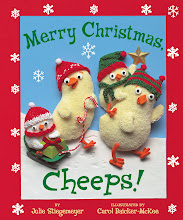
This piece is a very simple one, one of several I made at my publisher's request as promotional giveaways to promote one of my books (Merry Christmas, Cheeps! by Julie Stiegemeyer, Bloomsbury, 2007). Paying to test it would of course be foolish on many fronts, but even a small simple piece like this has an insane number of components (at least 22 by my quick count), thus putting an end to cool promotional items. These matter because buyers for book chains base their orders on initial buzz for the book at BEA and other venues - and special promotional tactics get attention.
The photos above and below are of a piece I made for a charity, Robert's Snow, that raises funds for cancer research. The event honors the husband of the enormously talented and well-loved children's book author and illustrator Grace Lin, who was stricken with a rare cancer. Children's book illustrators are invited to create artwork on wooden snowflakes which are then auctioned. Again, mine is probably more complex than most, but many others are incredible 3-D creations too. (And little did I realize by adding a box intended for long term storage I'd be adding to the components in need of testing.) Some of the snowflakes by top illustrators fetch collectible level prices, but others are not out of question for hanging in a child's room. It's yet another very gray area under CPSIA, surely not one that anyone intended, but one that looms ominously over people trying to do a good thing nonetheless.

If you have a few more minutes, go check out this post at Deputy Headmistress's The Common Room. She finally found someone to kind of debate the merits (or at least intentions) of CPSIA with her. PJFry via BoingBoing mentions a number of the misconceptions about lead in books, and Deputy Headmistress walks her through the science and real-life reasons why they're wrong.

Thursday, March 26, 2009

CPSIA: Should Schools Be Exempt?


Illustration by Jessie Willcox Smith, public domain
There has been little discussion in the press or even the blogosphere about how schools will be affected by CPSIA - but that doesn't mean they aren't concerned, confused, and seeking guidance from both Congress and the CPSC. They are particularly worried about the ban on pre-1985 books (as well as the impact of testing on the costs of books and other supplies going forward), which flies in the face of the CPSC's assertions that schools have no pre-1985 books to worry about (more about this in a minute). 

Michael Resnick, Associate Executive Director of the National School Boards Association, wrote to the CPSC on March 6th, urging them to recognize the safety of books and exempt all of them. He noted that schools are concerned about liability even during the one year testing stay, and need some guidance immediately. So far, I do not believe any has been forthcoming (based on a discussion with a school official following the law and the lack of any follow-up correspondence on the NSBA website; I'm awaiting comment from their go-to guy).

Resnick further asks that schools be exempt from the law all together. A public school official I spoke with today (off the record) noted that her school district is well aware that many of their ordinary, necessary actions would classify them as "manufacturers" under the guidelines issued to small businesses etc. and thus either subject them to unaffordable testing or force them to drastically change the way they operate. For example, schools frequently assemble and bind packets and books for students to use and keep (with plastic comb, stapled, or glued bindings); they put together science kits; they make art projects that are intended for use by children; and many of their fundraising and charitable projects also involve "manufacturing" things for children. (For example, parents at my kids' elementary sell handicrafts, many intended for children, at the holiday shop that funds many school extras; the kids assemble toiletry-and-book packages for kids in homeless shelters; and the school sponsors book drives either to promote literacy or to donate to children locally or abroad.) Recognizing these issues, Mr. Resnick asks:
"As you continue to address enforcement and implementation issues, NSBA urges the Commission to exempt local school districts from the lead level requirements under the law; or at the very least, to establish a transition period that would enable public schools and libraries to meet the spirit and intent of the law without creating financial burdens on states and local communities in this dire economy and extreme reductions in their revenues. "

You can read the whole letter here


Meanwhile, the CPSC seems to be getting their information about how schools are affected from some other source - some unnamed "trade associations" (not sure who the public schools trade association would be). On page 17 of Nord's response to Rep. Dingell, the Commission asserts: 
Based on information from the trade associations with information regarding books in libraries and schools, the Commission staff understands that most textbooks in schools are less than ten years old. Likewise, the information received suggests that most library books lent to children are recycled approximately every 18 lending cycles or three years. Thus, it appears that few of the books being provided to children in their schools and libraries would be more than 20 years old.

The school official I spoke with today just laughed at that statement; she said if schools were forced to discard all their pre-1985 materials, they'd basically stop being operational. Although schools do strive to replace text books more often than that, occasionally they get stuck with a series for longer, especially in subjects where the information changes little (math for example) or where the books are for a minor subject (like Health). Not only is buying new sets of textbooks expensive, it's a slow process, more akin to turning an ocean liner than swinging a Mini Cooper around - it takes years for most districts to go through the textbook adoption process. The bigger problems though, are with things like classroom sets of novels (which get used for a few weeks at a time rather than all year), classroom libraries, and books in the school library, which most certainly not are not fully recycled every three years. 

Another problem for schools, libraries, and used booksellers, is the high number of books that lack accurate print date information. For example, the easy readers above (all still in good shape after heavy use by my 3 kids) were purchased new in the 1990s, and I suspect were printed sometime near then - but they all have copyright dates prior to 1985 and no print date information at all. A librarian I know said some libraries could track likely print dates through purchase records, but that would take hours of research, especially since few libraries had gone electronic in the mid 1980s. And it would still leave them uncertain in many cases and vulnerable to a dispute with a disgruntled patron. (Keep in mind the expenses of defending a lawsuit are typically not awarded even if you win, so every lawsuit is bad news.) If the law remains as is, they'll probably just toss questionable books. 

All of this is a huge headache for school districts - and for Congress and the CPSC. On the one hand, if they enforce the law for schools, they'll send school budgets out of control and probably deprive many students of necessary materials at least in the short run. On the other hand, if they exempt schools, they open themselves to the criticism that they either don't care about kids since they're willing to force them to wallow in dangerous lead-laden environments 6 hours a day, 180 days a year, or that lead in things like books and school supplies really isn't much of a threat to kids at all. It's basically a lose-lose proposition, which is probably why the CPSC guy I spoke with danced around the issue, promised to get back to me, and never has. And my congressmen have been utterly silent in response to my specific questions too.


The book above, about a school that's as ridiculous as the CPSIA, is much funnier than the law because it's fantasy. It's also not clear whether it's a banned book, since it was printed in 1985. For quite a while, CPSC seemed to be using that as the year that was safe going forward, which would make this copy okay to sell or distribute - but more recently, agency spokesmen have been using a new cut off year - 1986 - which would make it toxic waste. (See, for example, this AP article).
These books above are all well used cheap paperbacks, all printed in the 1970s or earlier. The pages have yellowed a bit and a couple of the most heavily read have mangled spines (like the copy of The Four Story Mistake by Elizabeth Enright which was part of the "Bathtub Books" collection in my family growing up - it's a really excellent, old-fashioned yet timeless story about a large family living in an interesting old house in the 1940s). But all are perfectly usable - and are still re-read by me and my kids occasionally and are similar to books still found in many classroom libraries. This is part of what CPSC doesn't get - old books, even the cheap, not particularly well-made ones, typically have very long lives. The good quality hard covers go on and on and on, and may well outlast new paperbacks. I can only remember having thrown away about a dozen books in my whole life - I've donated or passed along plenty of others - but few have been in such bad shape they only deserved tossing. 

One funny note about ratty paperbacks: one of my kids used to consistently select the most bedraggled looking copies when I gave the kids money to get a book or two at a library sale or used bookstore. When I asked him why he picked those particular books over the nicer ones, he said (quite logically) that the beat up ones had obviously been read many times which meant they were probably good.
Illustration for Ring o' Rosies by L. Leslie Brooke, public domain

Finally, a reminder to consider joining the April 1st rally in DC, either in person or via the webcast at www.amendthecpsia.com. And check out recent coverage of the law on Walter Olsen's Overlawyered, the Deputy Headmistress's Common Room, Valerie Jacobsen's Bookroom Blog, and Rick Woldenberg's Learning Resources, Inc. blog. (I have no idea why Blogger is underlining all this text, but it won't stop!)

Tuesday, March 24, 2009

CPSIA and Vintage Books 6: Rally 'Round!


Illustration by Marjorie Torrey, copyright, 1956, Random House
The illustration above (and the close-up detail below) are from my childhood copy of Favorite Nursery Songs, compiled by Phyllis Brown Ohanian and illustrated with delicate watercolor and pencil pictures by the Caldecott-honored Marjorie Torrey. The book, my favorite songbook when I was growing up, was published in 1956 and has been out of print ever since.
Detail from "Ring Around a Rosy"
More about Ms. Torrey's charming illustrations in a minute, but first I want to encourage everyone who can possibly make it to join me in a trek to Washington D.C. for a fly-in, rally, and Congressional briefing on Capitol Hill to amend the CPSIA. You can get all the details, including the info on hotels offering special deals for the event, at a special website here.

Rick Woldenberg of Learning Resources, Inc. (see his CPSIA blog here) has been helping to organize people from many affected industries, large and small, to get our voices heard by Congress. I'm trying to schedule meetings with my senators and representative as well - and I'm taking my teenage daughter, so she can see political activism at work in person (and put in her two cents worth too). I'm planning to leave from Pittsburgh very early on the morning of the first and return in the evening. I have a minivan, and if anyone from the area needs a ride, just shoot me an email and we can work out the details.

Copyright Random House, 1956


Detail from cover
Isn't the cover of this book beautiful? The quality of the color reproductions was really quite remarkable for the era, too. You can readily see the rough texture of the watercolor paper, as well as the soft layers of washes and the nuances of the pencil lines. I think it's notable that these images still come vividly to mind more than 45 years after I first saw them the moment I hear the familiar first lines of songs like "Row, Row, Row Your Boat" or "Here We Go 'Round the Mulberry Bush."

Here's a glimpse of the illustration for the former song, as well as a closer look at a couple of the figures. There's a real sweetness, without veering into saccharine. The botanical elements are consistently precise and beautiful. 


I spoke recently with Joe Martyak, the chief of staff at the CPSC, for information about how CPSIA affects children's books, literacy programs, libraries, and the sale of the original art from children's books for an article I'm writing for the Society for Children's Book Writers and Illustrators (SCBWI - visit their website here) and for an opinion piece with a similar theme I'm working on to submit to the Pittsburgh Post-Gazette (which ran one excellent article on CPSIA and dirt bikes but has otherwise ignored the whole thing). Although much of what Mr. Martyak told me could be construed as encouraging from a short-term perspective (he didn't think the CPSC would be going after libraries, literacy groups, booksellers, etc. any time soon due to low priority and lack of resources), my overall mood is one of gloom for the future of children's literature's past unless Congress agrees to try again with the CPSIA. He was clear that their preliminary testing  finds many older books hovering around the 300 ppm level - the standard which goes into effect in August. (This is destructive testing because XRF testing is not particularly helpful for books since it can only measure the lead in a particular spot which tells you little about total lead) An even stricter standard of 100 ppm goes into effect in August, 2011, at which time my guess is that few old books will pass.

Mr. Martyak did his best to ask my specific questions, but it's clear there's just much that he and the agency have not yet figured out. And that of course is just one of the many, many problems with passing a tsunami of a law and rushing it into enactment: there are a nearly limitless number of details and judgment calls with a law like this, and no matter how hard-working or well-meaning the folks at CPSC are, they will simply not be able to sort them out any time soon, not in the next year, probably not in the next five. For example, he had no idea how the law would be applied with regard to schools (who become manufacturers under a strict reading of the law when they create unit packets with comb bindings - or when they even just staple a pile of papers together). He thought that the publishers who produce inexpensive staple-bound paperbacks could get away with just testing the staples (since for now "ordinary books" are exempt from testing), but it sounded to me in other published CPSC advisories like deviating from the ordinary book definition meant the whole product had to be tested. And Mr. Martyak had not realized the agency had used different definitions of ordinary books, nor whether that signaled a shift in interpretation.
I love how she handled the challenge of facing pages that couldn't really bleed together, given the printing limitations at the time.
Aren't the cherry blossoms breathtaking? And they should be in bloom on April 1st for the rally. Of course, that baby should be sleeping on his back, in an approved, labeled crib. Hope there aren't any fasteners or phthalates in that sleeper. On the whole, I think the CPSC investigators would have a field day, as would CYS.

Right now, those of us who oppose the CPSIA are largely at the wind-blowing stage. (The ATV industry and the thrift stores too are past that though). But the bough-breaking phase is not far off - next February 10th will herald both the testing and certification mandates - and the end of many more businesses and safe, useful products. We need to take action now, before disaster strikes.
Not sure if this guy is looking for his little dog, or for the toys, books, and clothes he used to have.

One of the extra elements common in older books are illustrated endpapers, like those above. You still see them in some picture books today, but much less frequently since they're an added expense, as well as more work for the illustrator (who is generally paid the same whether or not the end papers are illustrated). Endpapers are not usually included when a hardcover is reprinted as a paperback, which is yet another reason to prefer the older editions.

The description below is from a bio of Marjorie Torrey (who was also an acclaimed mystery writer) by Tom and Enid Schantz that appeared in the Rue Morgue Press in 2002:
"But it was her work as an illustrator that brought her fame and awards. Her first Caldecott Honor book, Sing Mother Goose, with songs by Opal Wheeler, came in 1946. The following year she earned another Caldecott Honor medallion for illustrating Sing in Praise: A Collection of the Best Loved Hymns, once again selected by Wheeler. A Caldecott historian wrote of her work: 'The full-color illustrations reflect the solemnity and reverence seen in Torrey’s Mother Goose collection, and these interpretations communicate the essence and importance of the songs’ words…Torrey’s gentle black-and-white illustrations possess the softness of pencil, some the sharp lines of pen and ink, and others a combination of both.'...All of her books are out of print today. Even her Caldecott honor books are difficult to find, often confined to rare book rooms or the special collections section of larger libraries."
You can read the whole article here. And despite the rarity of her books (which my attempts at searching for them confirm), you can still find a few inexpensive copies (see these amazon listings for the song book I own), meaning the volumes likely won't qualify as collectibles under CPSIA standards - so better get a copy while you can.
Ms. Torrey was also well known for her version of Alice in Wonderland.
I'm hoping someone decides to republish her work.

Here are two more CPSIA articles on books in the MSM: a Washington Post article that ran in the health section, and one from the St. Petersburg Times here. Very discouraging, but I think Congress ought to take a look at the typical comments about this law. Don't know who those constituents are that they claim are pestering to preserve the law unchanged, but they're not exactly vocal in public.